
David Fincher Reveals the ‘Alien 3’ He Pitched: ‘The Wretched,’ the Prison Planet, the Star Wars Droid Movie and What It Means for the Franchise Now
Thirty-four years after Alien 3 limped out of a production so troubled it became a film-school cautionary tale, David Fincher has finally laid out, in plain terms, the movie he walked into Fox's offices to make. Sitting down with Josh Horowitz on the Happy Sad Confused podcast, the director of Se7en , Zodiac and Gone Girl walked back through the pitch that got a music video director handed the keys to one of the biggest franchises in the world. And the strange thing is, he still thinks the idea was good. It was everything that happened after the pitch that broke.
That matters for more than nostalgia. The Alien series in late 2026 is a franchise with a hit TV show in production, a box office smash whose sequel is stuck in limbo, and a founding father who reportedly can't let go. Fincher's comments land right in the middle of that, and they amount to a pretty clear lesson about what this series does best. Below: exactly what Fincher said, the long and ugly history of how Alien 3 got made, the numbers, and what his "wretched" pitch says about where Xenomorphs should go next.
The pitch: "What about the wretched?"
Fincher framed his idea against the first two films, and it is a sharp piece of story logic. In Ridley Scott's 1979 original, Ripley's last-act gamble is going back for Jones the cat. In James Cameron's Aliens , she goes back for Newt. Each film, in other words, ends on a rescue. Fincher told Horowitz he wanted to flip the question entirely: instead of asking who Ripley would save, ask what happens when the monster gets loose somewhere nobody is ever coming to save anyone. According to Dread Central's write-up of the interview, he summed it up to the room as "what about the wretched?"
The wretched, in his version, were the inmates of Fiorina 161: men no company would bother to rescue and no warden would ever think to arm. Ripley crash-lands among them, the creature arrives with her, and the prisoners, who have no guns, no training and no future, come to a collective decision. As ComicBookMovie reports, Fincher described them banding together around one idea: "We are all going to die tonight." The only dignity left, in his telling, is making sure the thing dies with them.
Fincher said he pitched this to Sigourney Weaver and to producers David Giler and Walter Hill, and that it is what won him the job. He also told Horowitz the core of that pitch still holds up today, which, coming from a filmmaker who has spent three decades treating this movie like a burn scar, is a notable thing to admit. iHorror, which covered the interview on November 25, points out this is how a music video director ended up with an Alien sequel. Dread Central adds that Fincher had a few unflattering things to say about studio culture in the same conversation. He did not spare the executives.
Bonus: the Star Wars movie that never was
The same conversation turned to another franchise. Per ComicBookMovie and Unboxholics, Fincher revisited the Star Wars idea he once floated to Lucasfilm's Kathleen Kennedy: a film told from the point of view of C-3PO and R2-D2, two servants watching the people who own them make the same mistakes over and over. It never went anywhere. But notice the pattern. Hand Fincher a beloved space franchise and he goes straight for the people at the bottom of the ladder. That is not an accident. It is a worldview.
Watch: no official clip yet
We couldn't verify an official, studio- or show-owned video of this specific segment, so we're not embedding one; we don't run re-uploads. The full conversation lives on Happy Sad Confused , Josh Horowitz's long-running interview show, and it is worth hearing Fincher tell it in his own deadpan.

Photo: Sigourney Weaver via Wikimedia Commons ( author and license).

The backstory: a sequel that ate its writers
To understand why Fincher's pitch landed, you have to understand the wreckage it landed on. Alien 3 went through more drafts than most franchises go through films. According to the film's production history, Giler and Hill approached cyberpunk novelist William Gibson in September 1987, and he turned in a script by that December. It was never shot, though it later became a comic, a 2019 audio drama and a 2021 novel by Pat Cadigan.
Renny Harlin, fresh off A Nightmare on Elm Street 4 , was attached for a while and left. Eric Red wrote a draft in early 1989 that the producers rejected and that Red himself later disowned. David Twohy took a pass that moved the story to a prison planet, which is where the Fiorina setting was born. Then New Zealand director Vincent Ward arrived with the most famous "what if" of the bunch: a wooden planet populated by monks. Ward was eventually dismissed after clashing with Fox over changes, and Giler and Hill stitched his story elements onto Twohy's prison concept. Film Stories counts more than ten writers across 1987 to 1990.
Meanwhile, Fox's marketing team was already selling a movie nobody had made. The studio's teaser famously showed an alien egg hanging over Earth and promised a 1992 Earth-bound invasion. The finished film never sets foot on our planet. That teaser is now a collector's item of studio overconfidence.
Fincher was hired into that chaos as a first-time feature director whose résumé was mostly music videos, including Madonna's "Express Yourself" and "Vogue." Filming began January 14, 1991, at Pinewood Studios with no finished script and millions already spent. Original cinematographer Jordan Cronenweth left early due to illness and was replaced by Alex Thomson. Scenes were rewritten on the fly. In postproduction, Fox reportedly cut around half an hour from Fincher's version.
By the numbers
- Release: May 22, 1992, Fincher's feature debut. Runtime 114 minutes.
- Budget: roughly $50 million to $60 million.
- Opening: No. 2 over Memorial Day weekend with about $23.1 million, behind Lethal Weapon 3.
- Gross: about $55.5 million domestic and $159.8 million worldwide per Box Office Mojo. Fox claimed it as the series' best worldwide total at the time.
- Reception: 43% on Rotten Tomatoes, 59 on Metacritic, a "C" CinemaScore. One Oscar nomination, for Best Visual Effects.
- The do-over: the 2003 Assembly Cut, built without Fincher's involvement, runs roughly half an hour longer and swaps the dog host for an ox.
For context: Alien: Romulus made roughly $350 million worldwide on an $80 million budget in 2024, per CBR, second only to Prometheus 's roughly $403 million. Alien 3 wasn't a flop overseas, where it made more than $100 million. It was a domestic disappointment and a reputational one, and Fincher has said for years, including in a 2009 Guardian interview, that nobody hated it more than he did.
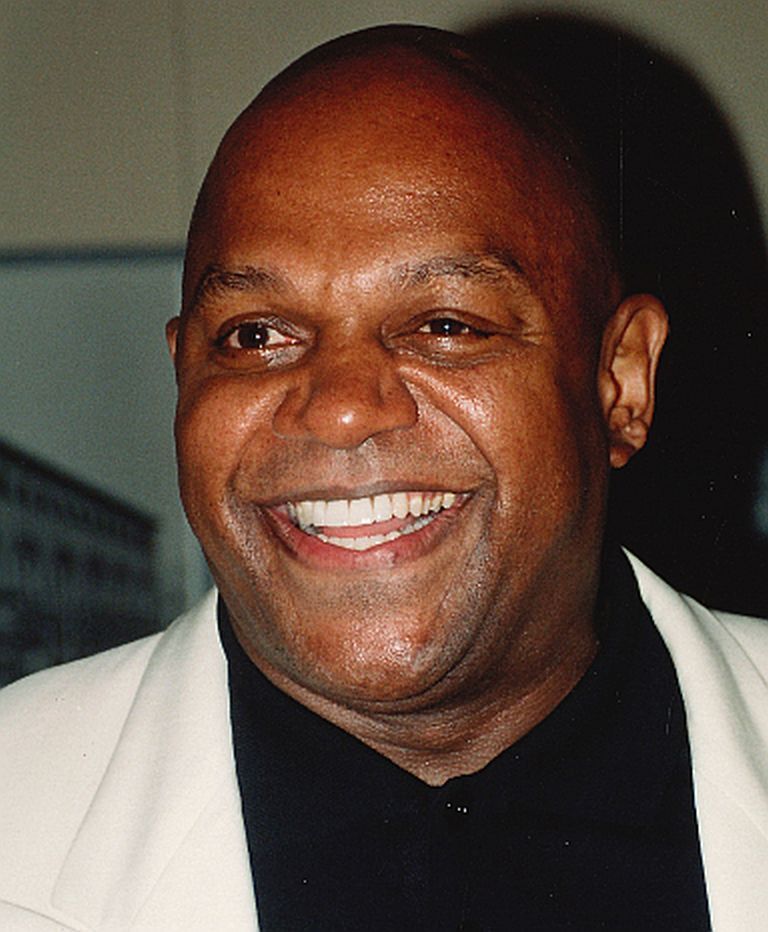
Photo: Charles S. Dutton via Wikimedia Commons ( author and license).

Who made the wretched work
Here's the part that gets lost in the "troubled production" story: the cast Fincher assembled to play his wretched is terrific. Charles S. Dutton's Dillon, the prison's self-appointed preacher, is the beating heart of the movie and the clearest expression of Fincher's pitch; he's the man who turns a doomed population into a congregation. Charles Dance brings real warmth as Clemens, the disgraced doctor. Paul McGann's Golic, Pete Postlethwaite, Brian Glover, Ralph Brown and a young Holt McCallany round out a gallery of faces that look like they've been rotting on Fiorina for years. Lance Henriksen returns as Bishop, twice over.
And Weaver, shaved head and all, gives arguably the most brutal performance of her four turns as Ripley. She signed on for about $4 million plus a share of the box office, and Fox president Joe Roth insisted Ripley stay in the film during development. Fincher's comments suggest she was in on his vision from the first meeting.
Analysis: Fincher just described the best version of this franchise
Strip away the production horror and Fincher's pitch is basically a thesis statement for what Alien has always been about at its best. The franchise isn't about Space Marines or godlike Engineers. It's about expendable people. The Nostromo crew are blue-collar truckers the company has already written off. The Colonial Marines are grunts sent on a corporate errand. Fincher just took that to its natural end: a planet of men who aren't merely expendable but already discarded.
Look at what has worked since. Romulus , the series' biggest hit in a decade, is about young colony workers trapped in an indentured-labor scheme who steal a ship to escape. Noah Hawley's Alien: Earth , which drew 9.2 million viewers in its first six days after its August 12, 2025, debut according to Tom's Guide, is built around corporations treating people, and people-shaped products, as property. Meanwhile, the films that leaned hardest into mythology and creator gods, Prometheus and Alien: Covenant , are the ones that split fans most.
That's why the timing of these comments is so pointed. Per MovieWeb, Fede Álvarez has confirmed he won't direct the Romulus sequel, Michael Sarnoski has been reported as a possible replacement, and Ridley Scott reportedly still wants to finish the David storyline from Prometheus and Covenant. CBR, citing an unconfirmed insider report from August, went further and said the sequel was effectively shelved amid creative friction, while 20th Century Studios chief Steve Asbell has reportedly pushed back on cancellation talk. Translation: this franchise is having the same argument it had in 1990, mythology versus the little guy, and the little guy keeps winning at the box office.
There's also a lesson here about process, and it's the one Fincher has been teaching for 34 years. A great pitch does not survive a production that starts shooting without a script, burns through cinematographers and gets recut by a nervous studio. Romulus worked partly because it was lean, mid-budget and handed to a director with a clear plan. Whoever ends up making the next Alien movie should be told the story of Fiorina 161 on day one.
What we still don't know
- Whether Fincher would ever revisit Alien 3 in any form. He has stayed away from the Assembly Cut and nothing in this interview suggests that's changing.
- Who directs the Romulus sequel, and whether it happens at all. No official announcement yet.
- When Alien: Earth season 2 premieres. It has been filming at Pinewood in London since summer 2026, with MovieWeb pointing to a possible late-summer 2027 return on FX on Hulu.
- Whether the studio ever lets a director make a truly bleak, nobody-gets-saved Alien film on purpose this time.
Bottom line
David Fincher didn't fail at Alien 3 because his idea was bad. By his own account the idea still stands up, and the best moments in the finished movie, Dillon's sermon, the prisoners choosing to go down fighting, are exactly the "wretched" film he pitched. What failed was everything around it. Thirty-four years later, a franchise with a hit show, a stalled sequel and a lot of competing voices could do worse than listen to the guy who learned that lesson the hard way.
Your turn: Is Alien 3 underrated, and which version do you watch, the theatrical cut or the Assembly Cut? Tell us in the comments.
Header photo: David Fincher via Wikimedia Commons ( author and license), cropped with text added.

Recent STories